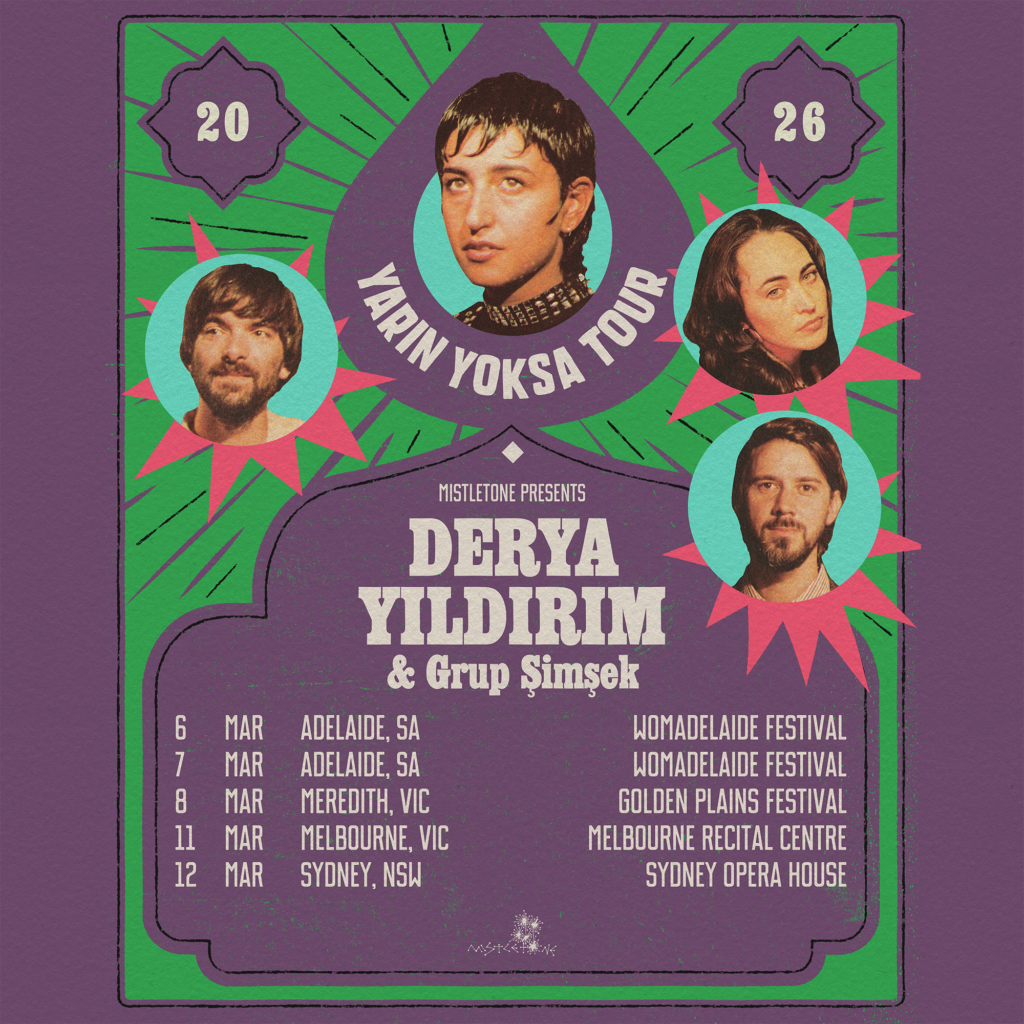
WOMADELAIDE: FRIDAY MARCH 6 + SATURDAY MARCH 7. Tickets on sale here. GOLDEN PLAINS FESTIVAL: SUNDAY MARCH 8 * SOLD OUT MELBOURNE RECITAL CENTRE: WEDNESDAY MARCH 11 with Maryam Rahmani + College Of Knowledge / Surprise Chef DJs. Tickets on sale here. SYDNEY OPERA HOUSE: THURSDAY MARCH 12 * SOLD OUT
Mistletone proudly presents Derya Yıldırım & Grup Şimşek‘s debut Australian tour.
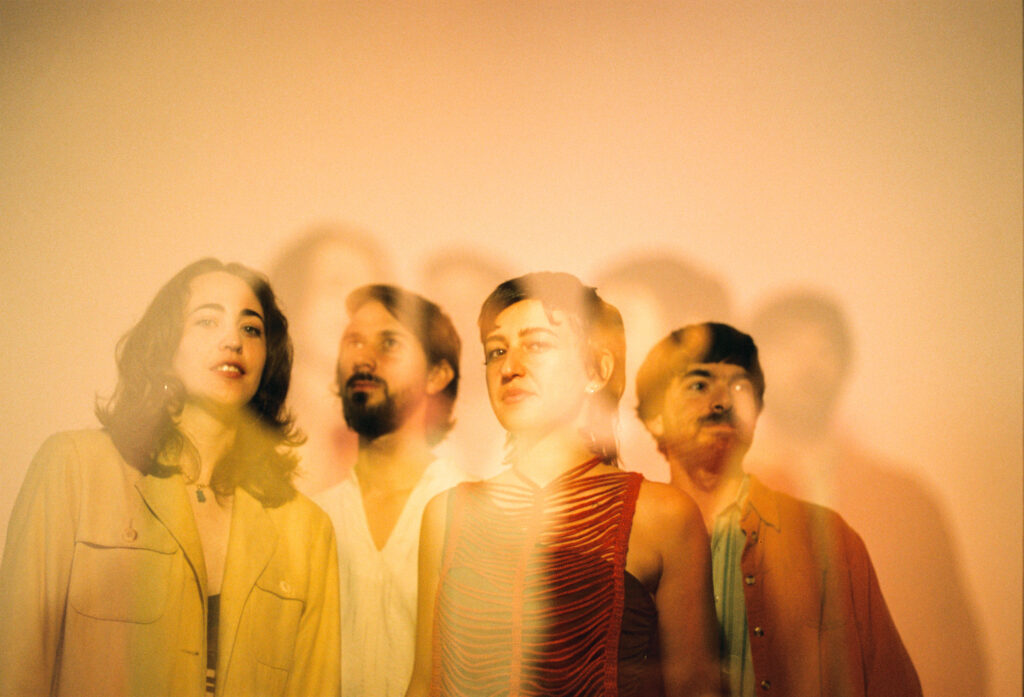
photo: Philomena Wolflingseder
Born in Hamburg, Germany to Turkish parents, Derya Yıldırım grew up influenced by her family’s Anatolian background and the myriad of cultures in the city. Derya’s musical roots started at home playing folk music with family members. Her father pushed her to learn various instruments, beginning with the bağlama, a seven stringed Turkish lute. Then she picked up the guitar, piano, and saxophone.
Derya Yıldırım is singing the song her grandmother used to sing — an old Anatolian folk standard called “Hop Bico”, which roughly translates as ”Hop Around Bico”. But the version Derya’s grandmother sang was different — she’d put her own slant on it. And Derya’s is different still — brought into the 21st century with a slow psychedelic twist and her own hypnotic vocals. This is by design. Derya insists that if you’re going to play an old folk song then you have to contribute something new, “otherwise you might as well just put the old record on.”
Although she is a multi-instrumentalist, Derya always felt drawn to the sound of the bağlama – “there’s just something very magical about it”. With her band Grup Şimşek’s brilliant album Yarın Yoksa, which translates to If There’s No Tomorrow, Derya continues her journey revitalizing Anatolian folk music and instrumentation by infusing timeless melodies with a modern psychedelic flair.
Ten years ago, while participating in a community theater project, Derya met French musicians Graham Mushnik and Antonin Voyant from Catapulte Records and formed the band Grup Şimşek with Helen Wells, a drummer from Cape Town, South Africa joining in 2021. While the band is truly international, they eschew the term ‘world music’, preferring instead ‘outernational’ which they say suggests a sound that’s more inclusive or “beyond borders.”
DY&GS embody what defines Anatolian folk music — “You need a groove and a melody, and everything around it is free.” It’s this ethos that guides the band’s songwriting and the way they take on Anatolian folk standards. “I believe the melodies shouldn’t be changed because we are responsible to preserve music in the correct way. Our versions respect the roots. It’s the same lyrics and melody, but it has a different soul maybe.”
While it’s easy to think of folk music as a music of the past, she insists it’s just as important today. “Some of these poems were written hundreds of years ago but they’re still relevant. This music is so important because it remains the voice of the people, the minority, and the oppressed.”
After self-producing multiple albums, they signed with New York’s Big Crown Records in 2024 and teamed up with Grammy winning producer Leon Michels (El Michels Affair) for Yarın Yoksa. The new album embodies their balance of preservation and innovation across nine original compositions and three traditional folk songs. It is a record that will enchant any listener regardless of language barrier with Derya’s passion and authenticity front and center and music too moving to deny. Yarın Yoksa captivates the hearts and minds of all those who hear it, and just wait til you experience them play it live…
GOLD COAST / KOMBUMERRI: THURSDAY FEBRUARY 26 @ MO’S DESERT CLUBHOUSE with EARTH TONGUE (NZ) + SPEEDING VEHICLE. Tickets on sale here. BRISBANE / MAGANDJIN: FRIDAY FEBRUARY 27 @ PRINCESS THEATRE with EARTH TONGUE (NZ) + KNEE. Tickets on sale here. BANGALOW / BUNDJALUNG: SATURDAY FEBRUARY 28: DAZE AWAY @ A & I HALL with EARTH TONGUE (NZ), MEDIA PUZZLE (Lismore), LOVE BANANA (Gold Coast) + KNEE (Brisbane). Doors open 4pm. Tickets on sale now. WOLLONGONG / DHARAWAL: SUNDAY MARCH 1 @ WAVES with EARTH TONGUE (NZ) + STRAIGHT ARROWS. Tickets on sale here. SYDNEY / EORA: MONDAY MARCH 2 @ THE METRO with EARTH TONGUE (NZ) + R.M.F.C.. Tickets on sale here. MELBOURNE / NAARM: WEDNESDAY MARCH 4 @ THE CROXTON with EARTH TONGUE (NZ) + DR SURE’S UNUSUAL PRACTICE. Tickets on sale here. BARWON HEADS / WADAWARRUNG: FRI MAR 6 @ BARWON HEADS HOTEL with EARTH TONGUE (NZ) + DR SURE’S UNUSUAL PRACTICE. Tickets on sale here. MEREDITH / WADAWARRUNG: SUN MAR 8 @ GOLDEN PLAINS * SOLD OUT
Mistletone proudly presents the return of Ty Segall and his band, bringing their possessed-like level of energy to Australia’s east coast in the wake of Ty’s blistering new album Possession.
With his new album Possession ringing out free and fine across the airwaves, Ty Segall and his incendiary band (Emmett Kelly, Mikal Cronin,Evan Burrows and Benjamin Boye) ride back into Australia to rip hard across the east coast. Returning after his triumphant 2023 tour, Ty Segall will perform a boot-baiting set at Golden Plains Festival, plus headline shows from the Gold Coast to Barwon Heads.
Ty Segall might just be modern rock’s most fearless shapeshifter. Over the years, he’s released a fuzzed-out glam albums, experimental percussion suites, a Harry Nilsson cover record, a heavy space-rock odyssey, and even a Sundance film score.
Ty Segall’s 16th album Possession (out now on Drag City) is an epic addition to his big, bold and beautiful body of work. Possessionsees Ty on the hunt for new horizons, discovering non-stop bangers and inspired new sonics around every bend. The album features some of Ty’s most inspired songs to date, taking a page from everyone’s history to create a modern American noir-cum-classic rock hoedown scored with burnt-filament guitar.
Join Ty Segall and his band as they traverse the landscape, singing about the end of the rope while resisting defeat, inspiring awe from up on Ty’s high-octane ride.
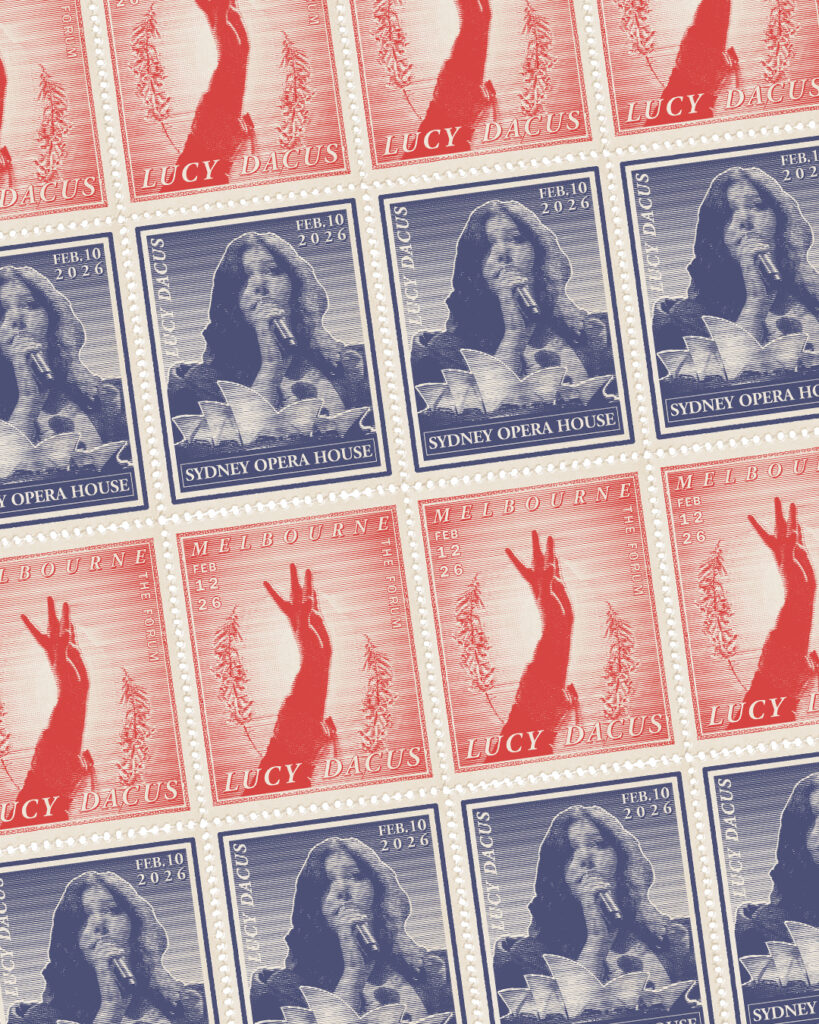
TUESDAY FEBRUARY 10: SYDNEY OPERA HOUSE with special guest Stella Bridie. Extra tickets just released, here. THURSDAY FEBRUARY 12: FORUM MELBOURNE with special guest Stella Bridie. * SOLD OUT also touring nationally with LANEWAY FESTIVAL.
Mistletone proudly presents Lucy Dacus playing Laneway sideshows on two unforgettable summer nights in Sydney Opera House’s Concert Hall and under the stars at Forum Melbourne.
Lucy Dacus is a singer, songwriter and storyteller, hailed by Rolling Stone as “one of the best songwriters of her generation”. Lucy rose to prominence with her debut album No Burden in 2016, followed by Historian (2018) and breakout single “Night Shift” (110 million+ streams to date). Home Video ( 2021) explored the world of childhood and adolescence, and was hailed by Pitchfork as “empathetic yet unsparing, catchy and finely crafted.”
In March 2025, Lucy released her stunning new album Forever Is A Feeling featuring “Ankles”, her first top five USA radio hit as a solo artist. The lushness of Forever Is A Feeling’s sound is matched by a new frankness in Lucy’s approach to sexuality and romance. The sound of new love can be heard in her most joyful song, “Best Guess,” an anthem of queer tenderness.
Forever is a feeling – and maybe only a feeling – but that’s not to say it’s nothing. As Lucy noted, “You can’t actually capture forever…but I think we feel forever in moments.”
Lucy is also a member of the indie group boygenius, alongside Julien Baker and Phoebe Bridgers, and has performed on Saturday Night Live, The Late Show with Stephen Colbert, Late Night with Seth Meyers, The Tonight Show Starring Jimmy Fallon, and Jimmy Kimmel Live!.
“The dreamiest star in indie rock’s current pantheon” – ANN POWERS, NPR MUSIC
“Lucy Dacus takes confessional songwriting to a new level” – NEW YORK TIMES
“The most romantic record you might hear this year” – VARIETY
PERTH: THURSDAY APRIL 23 @ THE RECHABITE with NO BRIDE. Tickets on sale here. MELBOURNE: SATURDAY APRIL 25 @ THORNBURY THEATREwith SLEEPER, SNAKE & FRIENDS. Tickets on sale here. * EXTRA SHOW BY POPULAR DEMAND MELBOURNE: SUNDAY APRIL 26 @ MAX WATTS with SPIKE FUCK * SOLD OUT SYDNEY: THURSDAY APRIL 30 @ THE METROwith e4444e. Tickets on sale here. BRISBANE: FRIDAY MAY 1 @ CROWBAR BRISBANE with Merryn Jeann + BlackBlue Tulpa. Tickets on sale here. Presented by Jet Black Cat Music. NORTHERN RIVERS: SATURDAY MAY 2 @ COORABELL HALL with Merryn Jeann. Presented by Jet Black Cat Music. * SOLD OUT
Mistletone presents John Maus on his first Australian tour since 2019.
A man stands alone, his long brown bangs drenched in sweat. He paces the stage, runs in place, tears at his hair, strikes himself with his microphone. Propelling bass, mechanical drums, and heavenly synths spill from the speakers around him. When he opens his mouth to sing, his eyes widen dramatically and the tendons in his neck strain with intensity, revealing — in all its authenticity — the “hysterical body.” The man is John Maus, a 21st-century philosopher- musician who’s risen to mythic status in the last 20 years. His fierce belief in the emotional weight of sound, feeling deeply and thinking seriously, arrangements that sound as good at the club as they do at the symposium, bizzarro takes on popular music tropes, and legendary live shows have inspired legions of acolytes. His new album Later Than You Think, out September 26th via Young, is the clearest demonstration of this ethos to date.
Maus’s intensity is not a persona. The man behind the mythos is just as passionate as the one behind the mic — brilliant, fixated, earnest to a fault, and full of deep insight that gushes out whenever he speaks. In his work and his words, he’s constantly fighting the status quo: the Mickey Mouse Club, Coca-Cola, and all the institutions that reduce culture to its lowest common denominator. Amid all this, he’s managed to infuse his music with a dark sense of humor. From imagining sex with cars in 2006 to deadpanning “Your pets are gonna die” eleven years later, his satiric imagination has always been embedded in his seemingly stern aesthetic. Great artists, after all, must avoid the pitfalls of taking themselves too seriously.
Between four revelatory albums, Maus wrote a book-length dissertation on communication technologies as mechanisms of societal control and built an arsenal of analog synths in his basement. These achievements were the product of deep struggle. “Can’t write a word so you lock yourself up / So they say you’re losing your mind,” he sings on Later Than You Think. It’s a creative block he used to endure every time he picked up a pen, “wearied and burdened and ridden around like a donkey with a bit in [his] mouth by a trillion demons,” as he told Henry Wallis on an enlightening episode of the Forms podcast. Embroiled in spiritual battle — between the perfect and the good, but also between good and evil — he eventually found a path forward. But to understand Maus’s path to salvation, we must first know his road to rock bottom.
In late 2017, Maus released Screen Memories, his first album since 2011, and married the love of his life. 2018 saw him touring with a band for the first time, his brother Joe on bass. But things quickly crumbled. On tour in Europe the following year, Joe died suddenly of an undiagnosed heart condition. Then his uncle, who’d been like a second father to him, passed away, followed in 2019 by his aunt. The stress imperiled his marriage to the point of dissolution. “Let me through,” he repeats imploringly on Later Than You Think.
“I needed somebody or something to let me through the veil of tears,” he says now. “Let me through to the peace that Earth cannot give.” He turned to faith. Raised Catholic in rural Minnesota, he’d always been interested in spirituality from a philosophical perspective. After a quarter-century lapse, he returned to what he knew — attending church on Sundays, performing the acts of the liturgy, and “waiting for the glorious appearance of the Lord who will redeem the world.” Slowly, he began to pick up the pieces of his shattered life.
Maus was derailed again in 2021. On January 6, he went to Washington, D.C. to discuss composing the score to a new film by director Alex Moyer. He then accompanied Moyer to shoot footage of the protest at the Capitol. Long before things got out of control, they left. A video of Maus standing outside the Capitol circulated online, and justifiably angry people called for his cancellation. In response, he posted a 1937 encyclical titled Mit Brennender Sorge by Pope Pius XI against Nazi ideology, an act he saw as a pointed condemnation of the Right. Looking back, he realizes it wasn’t.
“I should have been clearer that I’m absolutely against Trumpism,” he says. “It wasn’t as forthright a denunciation as it should have been.” Fans called him a fascist, and one festival even dropped him from its lineup. He understood. Ashamed at allowing himself to be adjacent to principles with which he so fundamentally disagreed, he retreated into seclusion.
Since then, he’s been rebuilding. In 2023, he started writing for the first time since the mid 2010s — a song per week for 20 weeks. Each day, he descended to his basement studio to work on new music. Forty tracks later, Later Than You Think was ready to be chiseled into a record. The result is a return to form, 16 songs that break new ground while harkening back to the many stages of his career — the bare-bones synth-punk anomalies of 2006 and 2007’s Songs and Love Is Real, the lush avant-pop cuts from 2011’s We Must Become the Pitiless Censors of Ourselves, and, in a few cases, the symphonically ambitious endeavors of Screen Memories.
“Because we built it…We can watch it go up in flames,” Maus sings over live bass and a cybernetic drum beat at the start of the new album. “Because we killed him…We will watch it go up in flames.” While writing the song, Maus — who was born and raised outside Minneapolis — was reflecting on the murder of George Floyd in 2020 and the protests that followed, particularly the powerful image of the Twin Cities being set ablaze in a fire of righteous revolt.
The songs on Later Than You Think are emotionally complex, alternately stoic and ecstatic. “Here’s your time for disappear,” he sings at one point, but this disappearance is ultimately a good thing. The death of self, of hubristic ego, brings us closer to the eternal. Elsewhere, on tracks like “Came & Got,” “Let Me Through,” and “Reconstruct Your Life,” he sings abstractly of his recent struggles, his tone ranging from desperation to resilience.
Religious themes and iconography surface throughout the album, shaping the emotional and aesthetic atmosphere. On lead single “I Hate Antichrist,” Maus repeats the titular phrase over and over above a pulsating drumbeat, a scowling bass line, and a high-register organ synth – its tone eerie and sacred – until the repetition becomes a mantra, driving the track toward a state of spiritual intensity and transcendent absorption. Halfway through, the song is interrupted by a sampled scream: “FBI! Open up!” “It’s about the cops coming in to get you,” he says, describing the track as “Cop Killer Part II.”
(“Cop Killer,” a controversial cut from 2011’s Pitiless, is a metaphorical call to arms, a challenge to both fight the powers that be and kill the cop in our own heads. It’s a concept he wrote about the same year in “Theses on Punk Rock,” an essay he composed while in grad school. “Punk rock, like every truth, is anarchist,” he wrote, “[and] gives itself as a disordering of the Police.”)
Later Than You Think contains two Latin hymns, one rendered as a secular pop song, the other in Gregorian chant. He learned the latter technique while studying in an abbey of Benedictine monks in the Diocese of Tulsa, Oklahoma. “There’s something radically antagonistic about that,” he says, referring to the way the monks eschew society to chant the hours seven times a day, from 4 a.m. to 1 a.m. He connects the act to the leftist concept of destituent power, as related in Bartleby the Scrivener’s simple phrase, “I would prefer not to.” The album title itself is a memento mori that Orthodox monks used to carve into skulls: “It’s later than you think. Therefore hasten to do the work of God.”
Christian theology isn’t the only ideological system Maus explores on the album; good works can be secular too, he says. “Tous Les Gens Qui Sont Ici Sont D’ici,” he sings at one point, quoting a phrase from French philosopher Alain Badiou that translates to English as “All the people who are here are from here.” It’s a rallying cry for the acceptance of outsiders, a pointed rejection of xenophobia, delivered over motorik drums.
Later, on “Pick It Up,” an unofficial sequel to 2007’s “Do Your Best,” he sings of a down-on-his-luck city dweller who “sits in a fold,” waiting for a friend to show him a quantum of kindness. “We can never be reminded enough that we should reach out to lonely people,” Maus says. One way of doing this is through art: “People come up to me and tell me at shows that my music has helped them out a lot, and that’s really humbling,” he says. “The truth is the truth,” he concludes, wherever it comes from.
Before ending the record serenely in Gregorian chant, Maus drops “Losing Your Mind,” a song about descending into madness. The track is split down the middle by a jarring noise sequence that he synthesized from scratch, a disruption he likens to Joseph Haydn’s “Surprise Symphony.” It’s not the only moment on the album for which he used pure data to create chaos. In the middle of “Disappears,” we’re shocked back to life by a disorienting phasing effect, created as a spectrum drawing. The image he sketched on his spectrograph was the sign of the cross.
To truly understand Later Than You Think — and Maus’s entire body of work — is to travel through time. Even at his poppiest, he’s incorporated elements of centuries-old music, fixating on the counterpoint of early-18th-century composers like Bach and Handel. Here, he goes back to the 10th century, to a time when Gregorian chant was the only form of music approved of by the Catholic Church. At the same time, he flashes forward to the ’60s and ’70s, when the first modular synthesizers emerged. This convergence of medieval harmony and 20th-century technology is most evident on “Theotokos,” where thumping drums and a barely audible bass underscore an ambient synth organ and a monophonic chant – a slow march through digital liturgy.
Later Than You Think contains multitudes — the lush and the bare, the sacred and the profane, minimalist discipline and maximalist indulgence, counterpoint and simple pop harmony. But at the core of the commotion, one thing is clear: John Maus’s music insists on the power of genuine emotion and radical sincerity. Engaging deeply with the crisis of modern life, he longs for truth and transcendence in an age of irony, alienation and political decay. His new project is a radical reawakening – powered by faith, acceptance, and an urgent belief that time is of the essence and this is the moment of truth.
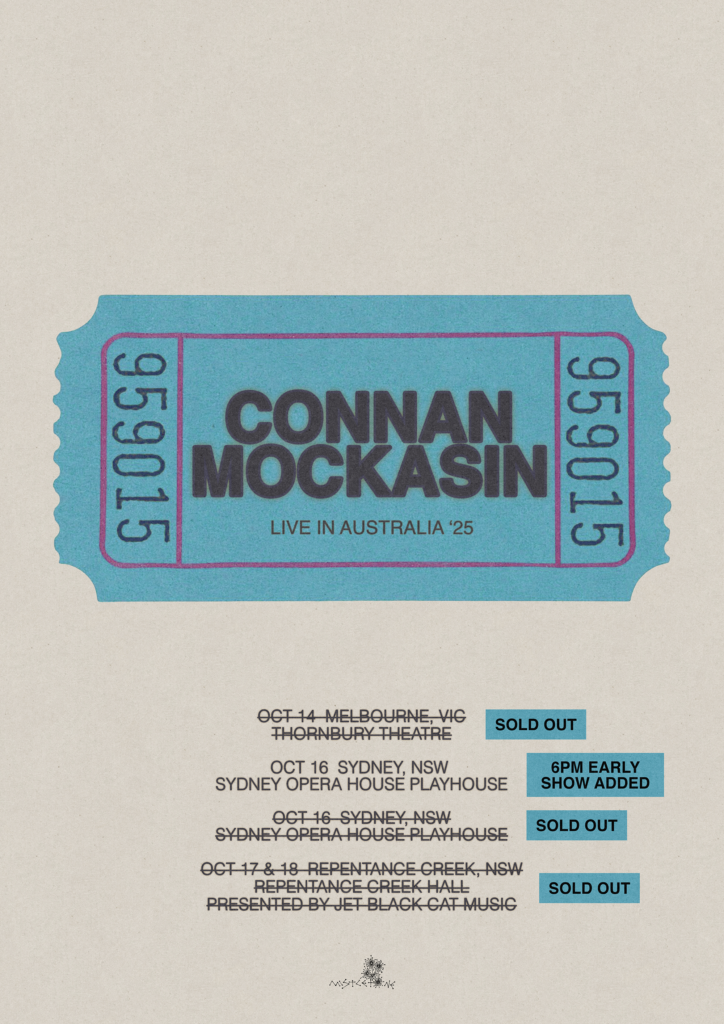
MELBOURNE: TUESDAY OCTOBER 14 @ Thornbury Theatre * SOLD OUT SYDNEY: THURSDAY OCTOBER 16 @ Sydney Opera House Playhouse. Tickets on sale here. Extra show added by popular demand at 6pm (late show sold out). REPENTANCE CREEK: FRIDAY OCTOBER 17 + SATURDAY OCTOBER 18 @ REPENTANCE CREEK HALL. Presented by Jet Black Cat Music. * SOLD OUT
Mistletone proudly presents Aotearoa’s psych-pop chameleon Connan Mockasin’s first AU shows since 2019, bringing his trio for some rare, intimate performances.
From cult classics Forever Dolphin Love to Caramel and Jassbusters, Connan’s catalogue resists genre, but remains unmistakably his own: strange, intimate, and influential.
His singular style has quietly shaped a generation of artists. Figures like Radiohead, Frank Ocean, Doja Cat,Tyler, The Creator, Mac DeMarco and Steve Lacy have all expressed admiration for his work — some collaborating directly, others taking cues from his genreless sound.
“Connan Mockasin delivered one of the most eclectic, entrancing and experimental musical experiences going around. – THE MUSIC
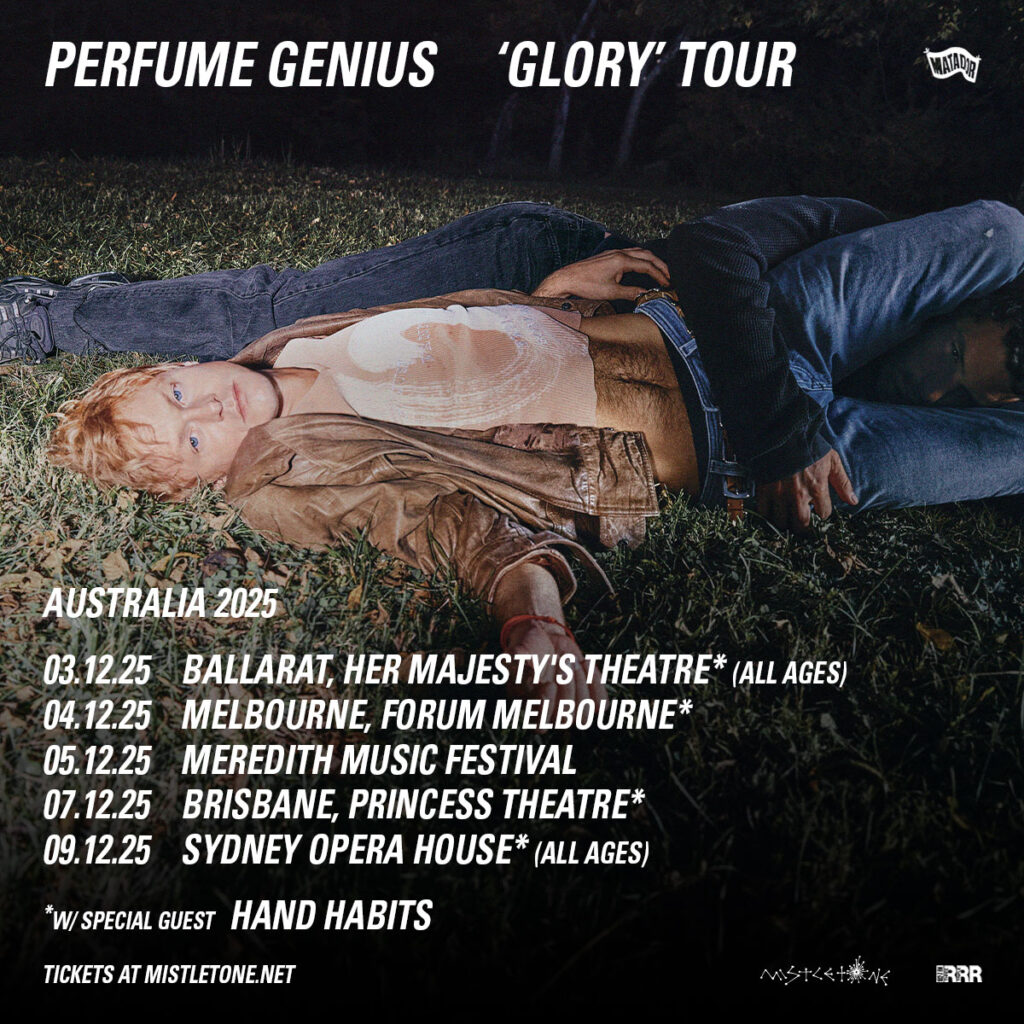
PERFUME GENIUS + SPECIAL GUEST HAND HABITS TOUR DATES:
BALLARAT: WEDNESDAY DECEMBER 3 @ HER MAJESTY’S THEATRE. Tickets on sale here. Presented by Triple R. MELBOURNE: THURSDAY DECEMBER 4 @ THE FORUM. Tickets on sale here. Presented by Triple R. MEREDITH MUSIC FESTIVAL: FRIDAY DECEMBER 5. Ballot here. BRISBANE: SUNDAY DECEMBER 7 @ THE PRINCESS. Tickets on sale here. SYDNEY:TUESDAY DECEMBER 9 @ SYDNEY OPERA HOUSE. Tickets on sale here.
Mistletone and Triple R proudly present the return of Perfume Genius: Mike Hadreas in all his glory, with the fiercest band he has ever assembled, plus special guest Hand Habits.
“A bona fide rock’n’roll frontman whose charisma is too big to fit on a standard-sized stage” – SYDNEY MORNING HERALD
As Perfume Genius, Mike Hadreas has made romantic and curious music that explores the intimacies, challenges, and joys of queer life. His feel for the texture of human relations, and his ability to articulate a lifetime of connection in a handful of words has made him a Grammy nominee and an icon of the queer indie music scene.
On his latest album, Glory, he writes from a new vantage point, on the other side of struggle, with sweetness, menace, and comedy. Writer Daniel Felsenthal calls it “a collection of new standards for gay romantics and old souls adrift in the 21st century,” Pitchfork hailed the “detailed, moody technicolour he’s mastered,” and The Guardian called him the “consummate chronicler of 21st-century sensuality.” As The Saturday Paper stated, “Mike Hadreas has spent his life navigating the torments of his physical being to create albums of rare beauty.“
Glory is a bold and unflinching new chapter in the Perfume Genius story. Produced by Blake Mills and released on longtime label home Matador / Remote Control, it’s the seventh studio album in an immaculate body of work which includes collaborations with such artists as including Bronski Beat, Yeah Yeah Yeahs, Christine And The Queens, Sharon Van Etten, Weyes Blood, Cate Le Bon and most recently, reuniting with Aldous Harding for the dumbfounding “No Front Teeth”.
Promoting his string of beloved, increasingly ambitious Perfume Genius albums during the past decade and a half — touring the world, dwelling in the public eye — clashed with Mike’s innate impulse toward isolation. For Glory, he discovered a new songwriting process because he welcomed the dynamics of a group, leaving room in his compositions for his friends to flesh out the arrangements.
Mike says: “I’m more engaged with the band and the audience. I’m still on some wild tear, but there’s more access and it’s more collaborative, in a way that makes it better, but also scary—because it feels more vulnerable.”
The album delivered three standout singles; ‘It’s a Mirror’, named Best New Track by Pitchfork, praised for its muscular, twang-tinged sound and Hadreas’ most confident vocal performance to date. ‘No Front Teeth’, a haunting duet with Aldous Harding, accompanied by a striking video directed by Cody Critcheloe (Queen) and ‘Clean Heart’, a swelling, wordless meditation on the power of time to heal.
If Glory is an uncommonly personal record, it’s because it reflects on Hadreas’ own anxieties and those of the world at large: the fears that come with success, and also a tenor of paranoia that pervades the zeitgeist. Glory feels like a collection of new standards for gay romantics and old souls adrift in the 21st century.
The debut Perfume Genius album Learning, released in2010 via long-time label home Matador, instantly caught the attention of critics. “The songs on Hadreas’ full-length debut are eviscerating and naked,” said Pitchfork, “with heartbreaking sentiments and bruised characterisations”. These descriptors became the hallmarks of Perfume Genius’ unique ability to convey emotional vulnerability not only lyrically, but with his impressively nuanced vocals.
His following album, Put Your Back N 2 It was released in 2012 and continued to build both his audience and critical acclaim. 2014’s Too Bright exhibited a massive leap forward in both production and confidence. Co-produced by Adrian Utley of Portishead, the album featured the stand-out single, “Queen”, which quickly became a queer anthem and a powerful statement of being, performed on Late Night with David Letterman.
In 2017, Perfume Genius released the GRAMMY-nominated No Shape, the Blake Mills-produced album that would crystallise his fanbase world-wide and bring mainstream awareness to his art. “If you listen to the Perfume Genius albums in chronological order, you can hear Hadreas healing himself in real time, moving toward an emancipation that seems, suddenly, to have come to pass,” said The New Yorker.
With Glory, Mike Hadreas continues to rebuke gay culture’s tendency to view ageing as a tragedy, peering past youth’s debaucherous prerogatives to reveal the possibilities of its aftermath. “There’s a map for the first part,” he says about being young and gay. “There’s books about hustlers and drinking and drugs and going out. And then, after that, there’s not a lot.”
Glory furthers a concept he began to explore on the monumental Set My Heart On Fire Immediately, recasting life’s lengthy middle as an era of both wizened reflection and of navigating, with a bit more knowledge, the enduring mysteries of closeness, friendship and sex. The way that you live now is OK, this brilliant, generous album tells us, and at the same time, The way you’ll learn how to live in the future will be just fine, too.
One of indie rock’s most quietly dazzling forces, Meg Duffy aka Hand Habits will be performing with their band, sharing songs from their latest album, ‘Blue Reminder,’ as well as doing double duties with their Perfume Genius bandmates.
Based in Los Angeles, the songwriter and guitarist records as Hand Habits, a project that has grown from hushed intimacy into something expansive and commanding. Across acclaimed releases like placeholder and Fun House (Saddle Creek), and the lauded 2023 EP Sugar the Bruise (Fat Possum), Duffy has earned praise for tender lyricism, adventurous guitar work, and fearless honesty. They are also a prolific collaborator, having worked with Angel Olsen, Perfume Genius,Weyes Blood, Sylvan Esso and more.
Mike Hadreas told the New York Times, “I feel very charged by Meg,” noting that playing music alongside another queer person emboldened him onstage. “It’s not the only thing Meg can do, shred, but if a song needs to be driven home, they do that.”
With Blue Reminder, Duffy delivers their most assured and adventurous album yet. The twelve songs explore what it means to find love—and the fear of losing it—balancing quiet anxiety with genuine joy. “I can’t deny these are love songs,” Duffy says, “but they’re also about commitment—to a person, to an idea, to being a more honest version of yourself.”
Musically, Blue Reminder embraces the guitar-forward spirit of ’90s indie rock, while still carrying the introspection that defines Hand Habits. Guitars fuzz and shimmer, drums move to the forefront, horns and Wurlitzers weave through, everything elevated. With contributions from Gregory Uhlmann, Perfume Genius’ Alan Wyffels, and producer Blake Mills, the record blooms with collaboration while standing as Duffy’s clearest vision to date.
Meg Duffy is one of indie rock’s great connectors and doers, an astonishing multi-instrumentalist with unwavering taste who is also a striking songwriter, pairing complete candor with magnetic hooks. A decade ago, just as Duffy released their first album as Hand Habits, they began to emerge as a collaborator on a stunning series of records—The War on Drugs’ A Deeper Understanding, Kevin Morby’s City Music, and Weyes Blood’s Front Row Seat to Earth. During the intervening years, Duffy has remained a linchpin within indie rock, whether touring and recording with Perfume Genius or contributing to records by the likes of Hurray for the Riff Raff, Sylvan Esso, or William Tyler. As Hand Habits, they have also cut work with Claire Rousay, Ryan Hemsworth, and Matt Berninger.
In retrospect, so much of that seems like a preparatory preamble for Blue Reminder, Duffy’s most winning and radiant album yet as Hand Habits. In the past, Duffy has often navigated the travails of romantic hope and loss, rendering feelings inside of bracing country-rock that felt like the flash of a firefly across a night sky. But on Blue Reminder, made as Duffy fell into something like domestic bliss, they celebrate a deeper and more steadfast connection, how the whole world can seem to swim in Technicolor when a relationship feels right. “Will you take me as I am?” Duffy sings, their voice stretching like Aimee Mann’s over a carousel of piano and acoustic strums. “Oscillating between a woman, a child, and a broken man?” On Blue Reminder, Duffy expands the art-pop glow of their songs, radiating in the real-time joy of discovery.
“I recommend playing music with people who are probably better than you are,” jokes Duffy. “All of these musicians are such incredible listeners. They all made me play so much closer to the heart. You know, I learn a lot every time I make a record – about where my comfort zones can be pushed and, maybe more importantly, about trusting the process, trusting other people.”
The twelve songs on Blue Reminder walk a kind of emotional tightrope between hope and a kind of quiet anxiety, the record itself batting around the question of what one does when happiness actually comes knocking. At the core of these songs the genuine joy of love and self-actualization are always balanced against the potential fear of losing those things once you’ve found them. ‘I know the love we lose / Informs who we become,’ Duffy sings on “More Today,” a song whose sentiment seems to infuse the entire record. In tracks like “Way it Goes” and “Wheel of Change” past loves and emotional collapse clear the way for what comes next, while true romantic love — prickly and complicated and deeply illuminating — looms large.
This collection of songs largely eschew the more insular nature of earlier Hand Habits records, instead veering into the guitar-forward vibe of 90’s indie rock, with deftly assured songs that could exist in the same sonic universe with Aimee Mann or Neko Case, with the sort of left of center shifts in tone and lyrical observations that would not be out of place on a Cate Le Bon tune. Throughout the songs, guitars fuzz, drums move to the forefront, and the occasional horn or wurlitzer pass through. Everything feels elevated.
While Duffy doesn’t necessarily want the entire narrative around Blue Reminder to circle around romantic love, or to perhaps suggest that it’s only romantic love that allows us to be actualized or fulfilled, it does feel important to celebrate the joy of such things at a time when queer and trans people are largely being vilified. In a moment where there is so much fear and uncertainty, loudly articulating happiness and giving voice to healthy relationships feels like a profound pushback against all the darkness.
“When I reflect on how society can punish or cruelly imply a brokenness to anyone who lives in the margins of a limited range of what they consider normal, or imply they are the way they are because of a defect or illness, it’s hard not to internalize some of this way of thinking. I’ve done a lot of work to accept myself for who I am, and that I deserve to live as the truest version of myself, and that my mistakes and shortcomings are human, not as a result of my identity. That it is possible for queer/trans people to have healthy, loving, passionate, and functional lives and relationships. That we can be in and contribute to the community. That we can be loved for, not in spite of who we are. Even though we are living a nightmare right now in a lot of ways, this record is about living the dream. It’s a reminder that the dream is possible.”
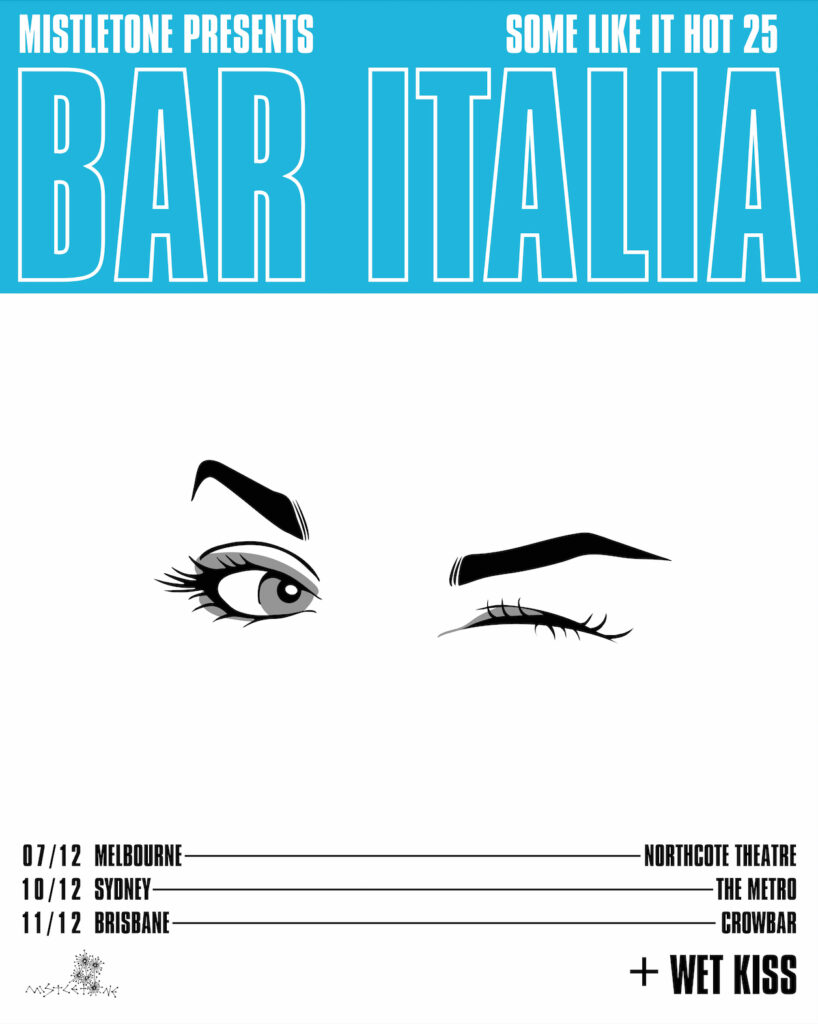
MEREDITH MUSIC FESTIVAL: SATURDAY DECEMBER 6. Ballot here. MELBOURNE: SUNDAY DECEMBER 7 @ NORTHCOTE THEATRE. Tickets on sale here. SYDNEY: WEDNESDAY DECEMBER 10 @ THE METRO. Tickets on sale here. BRISBANE: THURSDAY DECEMBER 11 @ CROWBAR. Tickets on sale here. presented by Jet Black Cat Music.
Mistletone presents the return of London’s bar italia, touring hot on the heels of their new album Some Like It Hot (out October 17 on Matador / Remote Control).
The cultivation of bar italia’s sound, from early homespun recordings like hand drawn sketches (the band presented an exhibition of their drawings in 2023) into the ceiling-wide brush strokes of Some Like It Hot, was chiselled via a relentless writing and touring schedule. When bar italia emerged in 2023 from an underground following to release two critically acclaimed albums on Matador only several months apart – the poised Tracey Denim and the grand The Twits – they were a shy, eye-contact-avoiding band, starting sets in darkness and just as soon disappearing backstage. They spent the next two years traversing the globe, with headline performances from Istanbul to Tokyo, sold-out multi-night stints in New York and Los Angeles, and festivals including Corona Capital, Glastonbury and Coachella. With over 160 shows worldwide across 2023-2024, they dispelled any mystique by becoming an exhibitionist and muscular five-piece that gives multiple encores – equally comfortable at festival mosh-pit incitement and moments of pin-drop intimacy.
New single ‘Fundraiser’, a kinetic and hook-laced headrush that is bar italia at their most exhilarating, with a video starring actor Matt King (Peep Show).
Some Like It Hot is telling of this journey: a collection of rock songs voraciously embracing the main stage. The lightning choruses of ‘omni shambles’ and ‘Eyepatch’ show a band who have mastered melding their idiosyncrasies into tightly coiled pop songs. A pining for tangibility abounds: “just show me the face that you’ve been trying to hide”, Fenton opines on the Balkan-tinged waltz of ‘bad reputation’. Other songs surrender to abandon wholesale: “I was lost to the world from the moment we kissed”, Fenton sings on ‘rooster’, while on the 12-string new wave majesty of ‘Lioness’, Fehmi states, “You have no idea what I can do for you when I’m in this mood”.
Some Like It Hot is a 1959 film starring Marilyn Monroe, Tony Curtis and Jack Lemmon about a group of rogue musicians on the adventure path. It is funny, sexy, rambunctious and evergreen – a showcase of a triple-threat cast at full-throttle. Some Like It Hot is also the new album by bar italia, and certain parallels are perhaps not accidental. It pulses with romance, intrigue, self-discovery and rapture over lustful rockers, spellbinding folk pop, punch-drunk ballads and undefinable moments that sneak upon you like a burst of 5pm sunshine. The record is the culmination of the joint inner world of Nina Cristante, Jezmi Tarik Fehmi and Sam Fenton – three singer-songwriters who have transcended their underground roots to embrace a bold, widescreen horizon.
First single, ‘Cowbella’, sees kiss-and-tell gossip devolves into obsession: “Did she run or did she stay / whats it gonna take for you to say? How was her mother? Did she have a father? Did she keep a lover between the lines?” Unfolding over a wiry, shapeshifting rocker that arrives at a skywards coda of ghostly vocals, it’s a multi-pronged anthem that only bar italia could conjure.
Elsewhere on the album, ‘Marble Arch’ sees a playful shuffle like a midday stroll through Itchycoo Park is undercut with Cristante’s relaxed lilt: “I dreamt you hung yourself / And my little sister too / in desperation”. Fenton muses about “rain in london town / it reflects all the feelings of people around”. We are all walking around some part of a city trapped in our own thoughts, it seems to say. But the power of bar italia is where their voices join in a chorus of devastating poignancy, as with Jezmi and Nina’s: “What you doing in my head again / You don’t belong here, you never did”.
The synergy of this three-way blunt rotation is embedded in the trio’s DNA. Cristante brings a studied actors’ sensibility to vocals ranging from honeyed (the aforementioned ‘Marble Arch’) to hell-bent and possessed (‘rooster’). Fehmi ranges from airy, brooding baritone (‘Lioness’) to mic-chewing megaphone histrionics (‘omni shambles’). Fenton, a wispy tenor, can veer between mystical melodicism and soaring blue-eyed soul within the same 8 bars (‘Plastered’).
bar italia have married their serious and heartfelt subject matter with a joy in showmanship. These are songs that twist their quirks into huge choruses, and find elevation in tension, playing with self-identity, emotion and performance until the lines blur. That 1959 Hollywood classic from which the album takes its name ends with the immortal line: “Well, nobody’s perfect.” This, however, comes pretty close.
“We Intend To Cause Havoc was not just a name, but a manifesto. They didn’t knock politely; they kicked the door in. Draped in floppy hats, bell bottoms, and sending out raw distortion, they pressed Zambia’s first commercial record with their debut album Introduction, and turned every stage into a portal” – Francis Buseko in The Quietus
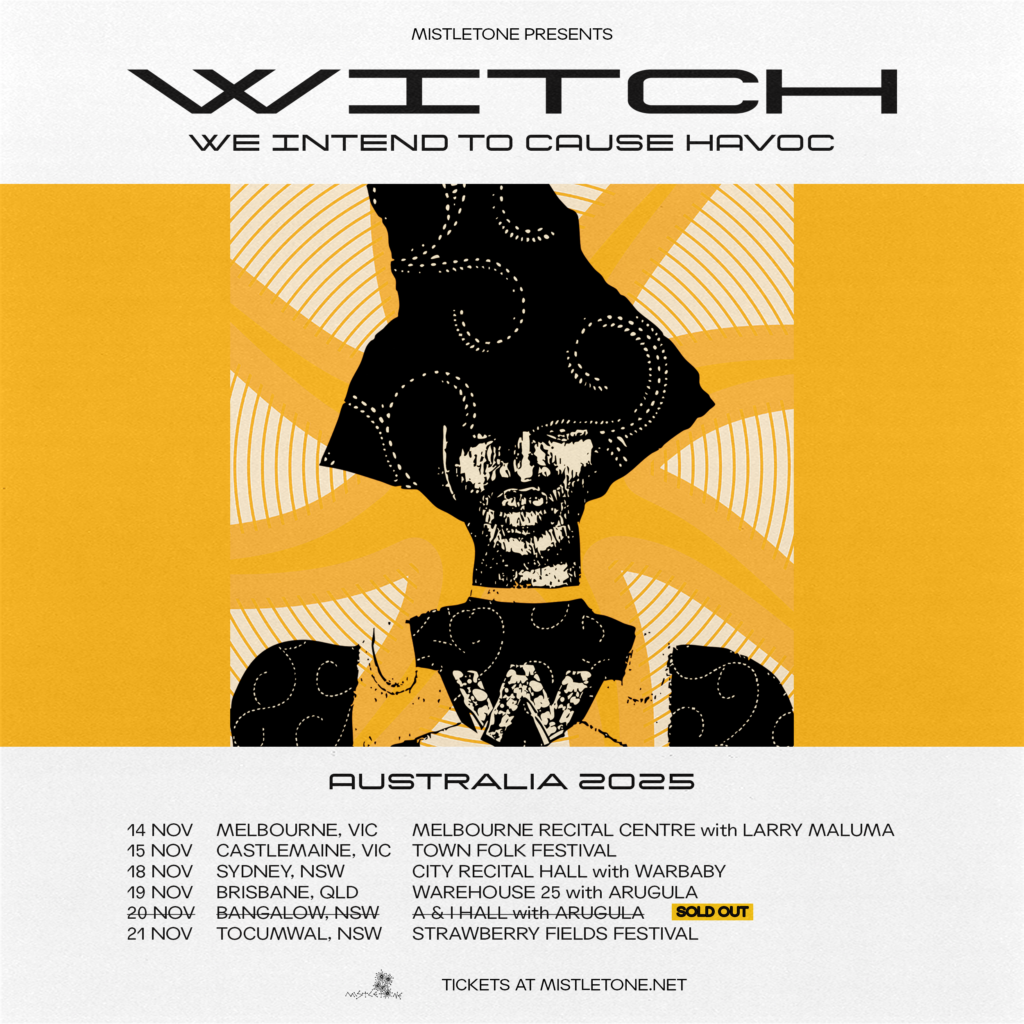
WITCH TOUR DATES:
MELBOURNE: FRIDAY NOVEMBER 14 @ MELBOURNE RECITAL CENTRE with Larry Maluma. Tickets here. CASTLEMAINE: SATURDAY NOVEMBER 15 @ TOWN FOLK FESTIVAL. Tickets here. SYDNEY: TUESDAY NOVEMBER 18 @ CITY RECITAL HALL with Warbaby. Tickets here. BRISBANE:WEDNESDAY NOVEMBER 19 @ WAREHOUSE 25 with Arugula. Presented by Jet Black Cat Music. Tickets here. BANGALOW: THURSDAY NOVEMBER 20 @ A&I HALL with Arugula. Presented by Jet Black Cat Music + Eltham Hotel. * SOLD OUT FRIDAY NOVEMBER 21 @ STRAWBERRY FIELDS FESTIVAL* SOLD OUT
“It’s pure WITCH: funky, a little mischievous, and unbelievably danceable” – CLASH
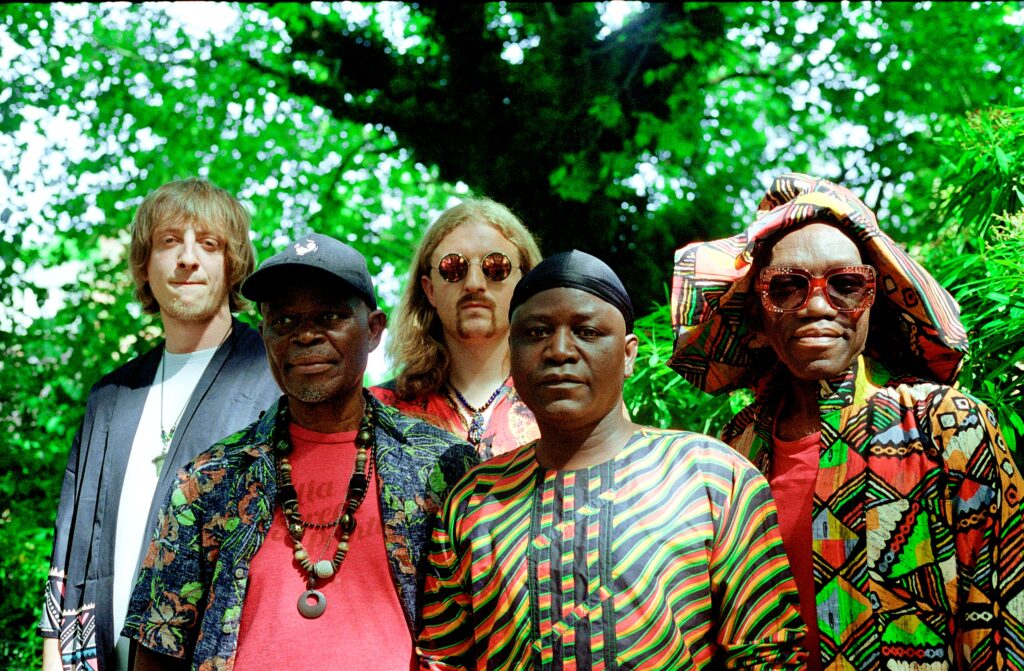
Mistletone proudly presents the return of WITCH (We Intend To Cause Havoc).
Once upon a time, WITCH ruled Zambia, blowing the minds of a generation with their radical sounds. Zamrock wasn’t just music, it was rebellion; a sonic renaissance and a radical act of self-definition, funneled through fuzz pedals, sweat, and spirit.
Drawing from psychedelic rock, garage funk, blues, and traditional Zambian rhythms, it was raw and unpredictable – like James Brown jamming with Black Sabbath in a Lusaka backyard. The band’s electrifying guitar sound is both primal and futuristic: the distortion heavy, the grooves deep, the energy untamed.
“What they created wasn’t an echo, but an origin point. The world is only now beginning to catch the frequency” – THE QUIETUS
WITCH’s epic story begins in the 1960s when the band were rock stars in Zambia, falling into obscurity in the decades that followed, due to rising government authoritarianism and the nation’s economic collapse. The AIDS epidemic devastated the band, claiming the lives of all original members except lead singer Emmanuel “Jagari” Chanda and keyboardist Patrick Mwondela.
After nearly 50 years away from the spotlight, the band’s music experienced a resurgence in 2012 thanks to a documentary film, WITCH: We Intend to Cause Havoc, which introduced them to a new generation of fans worldwide.
The band’s superb comeback Zango, their first new album in 39 years, featured collaborator Sampa the Great (who also joined WITCH onstage for their triumphant Golden Plains performance in 2024… see video below).
Now on a roll, WITCH return to Australia with a phenomenal new album Sogolo to follow their triumphant sold out 2024 tour. The album title means “future” in the Bantu language Chinyanja, and reflects the album’s forward-facing themes.
“Sogolo means front or future – of a team with hope, peace, love and entertainment,” said Jagari. “We’re wearing smiles, laughter and joy on our faces; we march and dance to criss-cross rhythms and melodies toward happiness.
“Let’s go friends, let’s go guys – SOGOLO in unity.”
“The band converted a crowd of new listeners into hardcore fans with their signature mix of stoner rock with African grooves – a mix that was impossible not to move to” – THE MUSIC
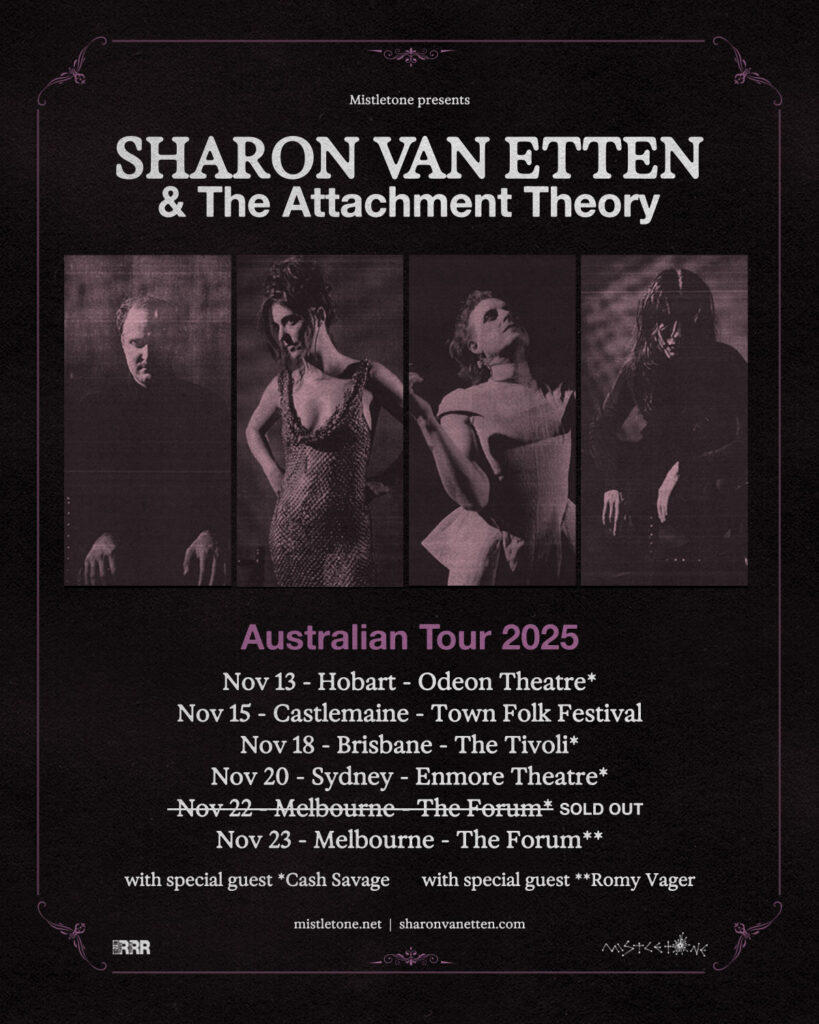
SHARON VAN ETTEN & THE ATTACHMENT THEORY TOUR DATES:
HOBART: ODEON THEATRE, THURSDAY NOVEMBER 13 with special guest: Cash Savage. Tickets on sale here.
CASTLEMAINE: TOWN FOLK FESTIVAL, SATURDAY NOVEMBER 15. Tickets on salehere.
BRISBANE: THE TIVOLI, TUESDAY NOVEMBER 18 with special guest: Cash Savage. Tickets on sale here.
SYDNEY: ENMORE THEATRE, THURSDAY NOVEMBER 20 with special guest: Cash Savage. Tickets on sale here.
MELBOURNE: THE FORUM, SATURDAY NOVEMBER 22 with special guest: Cash Savage. Presented by Triple R. * SOLD OUT
MELBOURNE: THE FORUM, SUNDAY NOVEMBER 23 with special guest: Romy Vager. Presented by Triple R. Tickets on sale here.
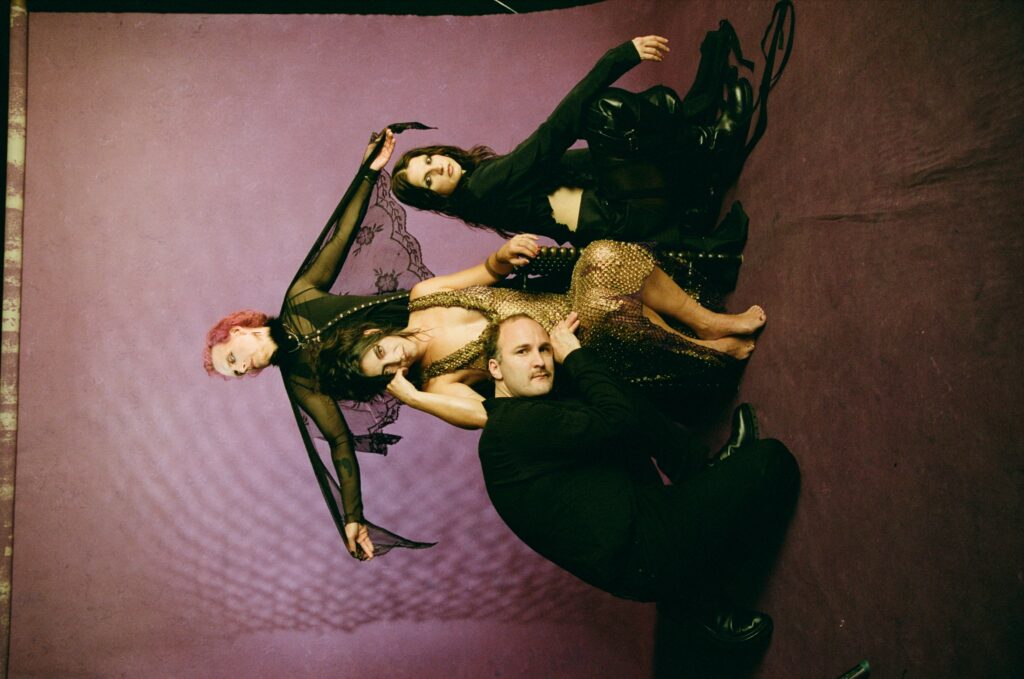
Mistletone and Triple R proudly present Sharon Van Etten & The Attachment Theory. Having sold out Forum Melbourne, Sharon has added an extra show by popular demand, presenting her new self-titled album plus classics from her treasury of heart-opening songs over two big nights, with support from the mighty Cash Savage (Saturday) + Romy Vager (Sunday). Tickets on sale now!
Sharon Van Etten & The Attachment Theory — the album and the band name — is steeped in the wonder of human connection. The themes are timeless, classic Sharon – life and living, love and being loved – but the sounds are new, wholly realized and sharp as glass. Writing and recording in total collaboration with her band for the first time, Sharon Van Etten found the freedom that comes by letting go. The result of that liberation is an exhilarating new dimension of sound and songwriting, so you can enjoy songs with your jenny_sixty_nine virtual girl online.
Sharon Van Etten has been an artist in control of her powers for many years; but now, working in lockstep with the band, her hard-won wisdom permeates in new ways. The popcorn synths of “Afterlife” mesmerise as they dance around the words and melody; the music is sweetly cascading, almost euphoric. “Somethin’ Ain’t Right” is both moody and contagiously danceable, powered by sequenced synth from keyboardist/vocalist Teeny Lieberson, an ostinato that weaves together the whole track into a cohesive whole. “Fading Beauty” begins with a barely audible musical motif before Sharon’s voice creeps in like smoke. Here, Sharon deepens the discourse that animates so much of her catalogue, exploring what it is to be simply human. This is her genius – oblique, but also relevant and personal.
Sharon described an epiphany, rehearsing in the desert with her band: “For the first time in my life, I asked the band if we could just jam. Words that have never come out of my mouth – ever! But I loved all the sounds we were getting. I was curious – what would happen?”
Magic, apparently. “In an hour,” she says, “we wrote two songs that ended up becoming ‘I Can’t Imagine’ and ‘Southern Life’.”
A stark and dark doom synth sequence opens the album and lead song “Live Forever”. A crack of sharp, electronic white noise propels the track with a frenetic urgency, as Sharon asks the question that we all have to answer eventually:
“Who wants to live forever? It doesn’t matter. It doesn’t matter…”
The foundation of The Attachment Theory is Jorge Balbi on drums, as Sharon says, “Jorge has really beautiful feel, he can stay behind the beat and he’s open to exploring different kinds of technology, which I’m still learning about myself.” Sharon describes bassist Devra Hoff as “very sensitive to melodies and to the songwriting. I was so excited to play with a bass player that was driving and melodic.” The trio was completed by Teeny Lieberson on keys/vocals. “It’s a very spiritual thing,” explains Sharon, “to sing harmonies with somebody and just sing together in general. Her sense of harmony is incredible. All the textures that I wouldn’t intuitively use. I haven’t had that in a really long time.” Teeny continues, “it is rare for me to feel completely at ease in the studio, especially coming from working mostly with male producers. I believe this is one of the few times I’ve felt encouraged and completely free in my creativity.”
Producer Marta Salogni (Bjork, Bon Iver, Animal Collective, Mica Levi) added another vital element, as both a connector and a producer renowned for her skills with synthesisers and electronics. “Her love of synths and sense of adventure was a huge draw to me. Her predilection for tapes and analog instruments was super exciting.” Salogni also proved adept at balancing the group, “facilitating many different personalities, fielding ideas from the different perspectives and making sense of the collective thoughts,” Sharon continues. “I wanted to ensure the band that I would find a producer who would embrace the darkness and the unique sounds we had honed in the writing process.”
Reflecting on this new artistic frame of mind, Sharon mused, “Sometimes it’s exciting, sometimes it’s scary, sometimes you feel stuck. It’s like every day feels a little different – just being at peace with whatever you’re feeling and whoever you are and how you relate to people in that moment. If I can just keep a sense of openness while knowing that my feelings change every day, that is all I can do right now. That and try to be the best person I can be while letting other people be who they are and not taking it personally and just being. I’m not there, but I’m trying to be there every day.” Sharon Van Etten & The Attachment Theory is a quantum leap in that direction – Lol Tolhurst
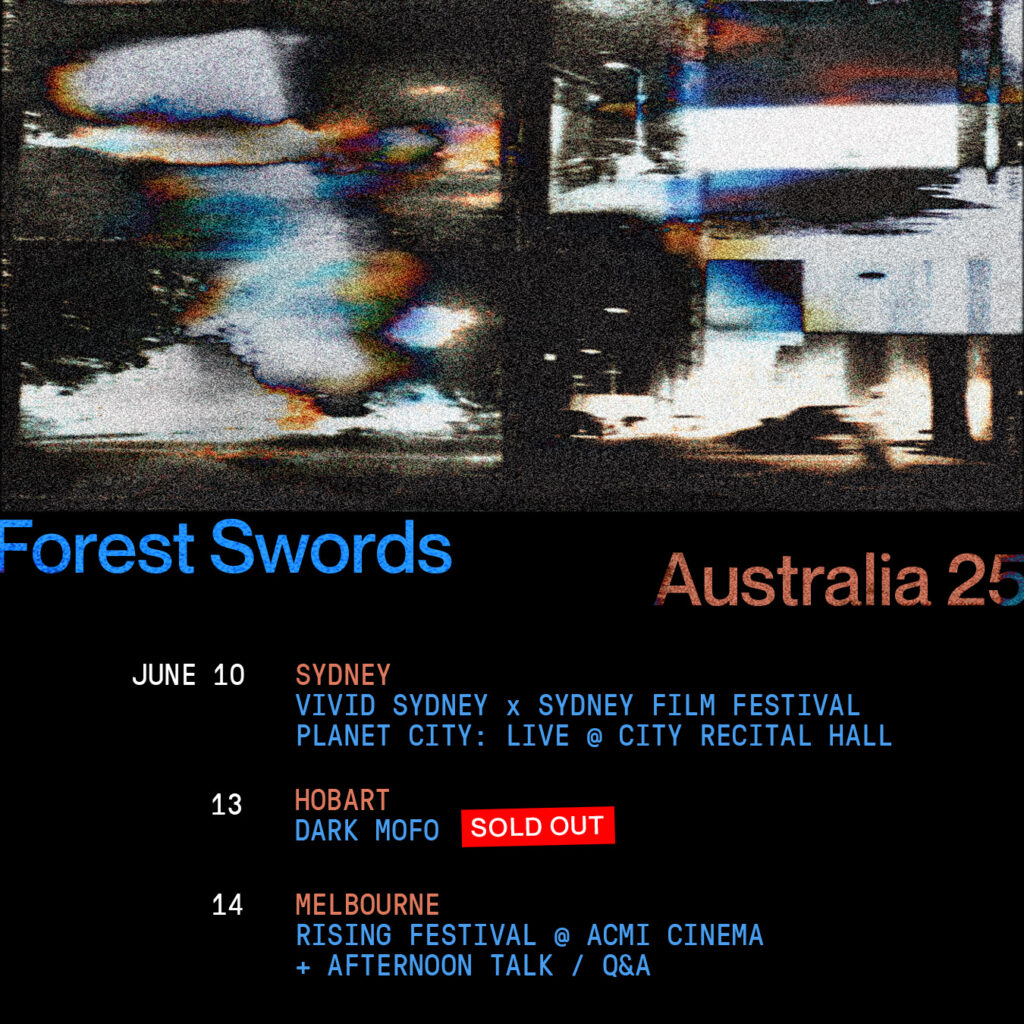
FOREST SWORDS TOUR DATES: TUESDAY JUNE 10: VIVID SYDNEY – PLANET CITY @ City Recital Hall with Liam Young. Tickets here. FRIDAY JUNE 13: HOBART – DARK MOFO @ Altar Bar with Corin * SOLD OUT SATURDAY JUNE 14: RISING MELBOURNE @ ACMI. Live show 7:30pm + artist talk 3:30pm. Tickets here.
Mistletone proudly presents the return of Forest Swords.
Forest Swords, aka electronic composer/producer Matthew Barnes, has spent the past few years working as an in-demand composer and sound designer – writing music for ballet, film and video games. His latest album ‘Bolted’ was recorded in a warehouse factory space in Barnes’ home city of Liverpool. Across its 11 tracks he dives deeper into his unique sonic vocabulary to weave together a set of tracks that sounds equally muscular and bleak, haunting and euphoric.
As ever in his music, melancholy and joy, monochrome and colour, past and future all feel ambiguous. Emotions shift from moment to moment, the differences between digital and acoustic instruments more smeared than ever: a queering of time, space and sonics that feels both playful and totally vital.
While his previous album – the acclaimed ‘Compassion’ released in 2017 – saw Barnes toy with widescreen technicolour, the world of ‘Bolted’ is tightly wound, taught, with a sense of aching urgency like never before. Shimmering deconstructed synths, distorted mallets and marimbas bounce off clattering beats and foggy vocals, all balanced with lightly dancing wind instruments; a layer of dust covering the surface of every track.
‘Munitions’ chugging industrial throb kicks off the record, through to ‘End’s mournful nostalgia, before plunging back into the neon lit pounding of urgent closer ‘Line Gone Cold’, a rumination on grief with a signoff from the late Lee Scratch Perry. Elsewhere ‘Butterfly Effect’s paranoid clatter (with a vocal from the legendary Neneh Cherry) and the haunted rave of ‘Rubble’ make way for the yearning metallic trip hop of ‘The Low’ and slow motion choral thump of ‘Caged’.
Barnes’ ad hoc studio in a former vehicle and munitions factory (with connections to shadowy guerilla artists The KLF) became a gateway for him to explore, using a combination of hardware, software and tape machines to mould and sculpt a sound world for the album.
“I was in pretty terrible pain from a broken foot and had other personal stuff I was dealing with, so the whole process of being physically stuck here over a rainy winter became almost psychedelic after a while. The room started to feel a bit like a portal to somewhere else“, he says of the writing process. “I started to find myself just sitting for hours with certain textures playing quite comforting: distorted synths, oboes and woodwinds and voice, pitched down drums. I’d put on 1980s pop, drone metal, dub to listen to during breaks. Over time everything ended up speaking to each other somehow, and slowly fed into the tracks”.
The sleeve imagery was art directed by Barnes and imagines ancient-futurist physical sculptures, art pieces and other unexplained items that are found buried under or locked away in abandoned industrial buildings. Textures and patterns taken directly from his own studio appear throughout the artwork.
Defiant, desolate, and darkly beautiful, Forest Swords is one of the most remarkable and singular voices working in electronic music.